

What Do Professional Associations Actually Do?
A Look at the Core Functions of Professional Associations and How REC Net Delivers Them
Many professionals belong to at least one professional association – but most members cannot easily explain what those organizations actually do. Beyond conferences and newsletters, professional associations help support individuals, strengthen industries, and shape professional identity. Different associations emphasize different priorities depending on their mission, membership, governance structure, volunteer capacity, and available resources.
In Program Planning for Parks, Recreation, and Leisure Services (2019), DeGraff and Jordan identify seven core functions commonly associated with professional associations:
- Networking
- Education
- Communication
- Recognition
- Advocacy
- Research
- Promotion of Standards
These seven functions provide a useful lens for understanding both what professional associations typically do and how REC Net contributes to the recreation, hospitality, and tourism professions as a relatively small, all-volunteer professional association.
| Networking |
Networking is often the most visible, and most immediately felt, benefit of professional association membership. Associations create spaces where professionals can connect across organizations, regions, and career stages, building relationships that support learning, collaboration, and career mobility.
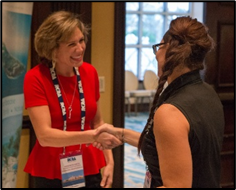
For many members, these connections are what turn an association from a logo into a community. Strong professional networks create opportunities not only for career advancement, but also for mentorship, problem-solving, collaboration, and ongoing support throughout a person’s career.
REC Net places a strong emphasis on relationship-building across professional settings and career stages. In addition to its annual conference, REC Net has expanded networking opportunities through virtual meetups and regional in-person gatherings, including a recent meetup in Orlando, Florida. These interactions help members remain connected throughout the year rather than only during conference season.
One of the strengths of REC Net is the depth of professional relationships that develop among members. Many REC Net professionals describe having trusted colleagues within the association whom they can contact for advice, support, or ideas when facing challenges within their organizations or communities. Over time, these professional connections often develop into lasting collaborations and friendships.
| Education |
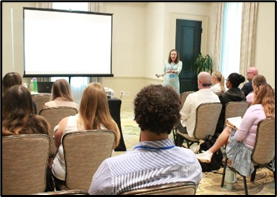
Professional associations play an important role in continuing education by offering learning opportunities that complement formal academic training. This can include conferences, workshops, panels, webinars, and practitioner-led sessions that focus on current issues, emerging trends, and applied skills.
Rather than replicating classroom learning, association-based education often emphasizes real-world problem-solving, peer learning, and professional reflection which helps members stay current and adaptable in a changing field.

REC Net supports professional education through conference sessions, panel discussions, practitioner-led presentations, as well as its annual Research Symposium. Furthermore, the educational topics often blend practical field experience with emerging industry conversations, allowing members to learn from both seasoned professionals and newer voices entering the field. In recent years, REC Net has also expanded educational communication through digital outreach, podcasts, and member-focused discussions that help maintain engagement between conferences.
| Recognition |
 Recognition is a powerful way associations affirm professional contributions that might otherwise go unnoticed. Awards, honors, and public acknowledgements help validate the work professionals do every day and reinforce shared values within the field.
Recognition also plays an important role in professional identity – particularly for students and early-career professionals – by signaling that their work matters and is valued by the broader community.
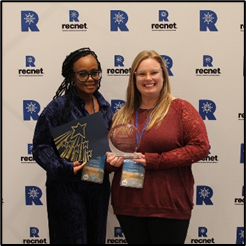 REC Net recognizes both emerging and experienced professionals through awards, conference recognition, and student engagement opportunities. In fields such as recreation, hospitality, and community programming – where much of the work happens behind the scenes – professional recognition can play an important role in reinforcing professional identity and celebrating meaningful contributions.
| Communication |
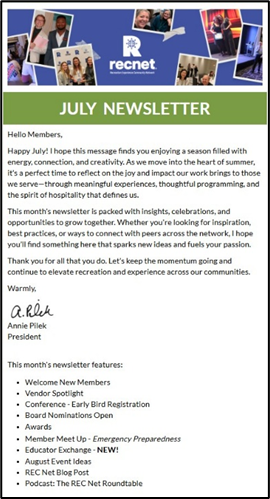
Clear, consistent communication helps keep members informed, connected, and engaged. Associations commonly share information through newsletters, announcements, job boards, and digital platforms that highlight opportunities, recognize achievements, and keep members connected to the broader profession.
Strong communication is often invisible when it works well, but it plays a critical role in maintaining continuity, transparency, and a sense of shared purpose among members.
Communication within REC Net occurs through newsletters, social media, member spotlights, and ongoing digital outreach. These communication efforts help members stay informed about professional opportunities, recognize accomplishments within the field, and maintain a sense of connection throughout the year.
REC Net’s job board also serves as an important communication tool within the profession by connecting employers with professionals seeking new opportunities and helping members stay informed about career openings across the industry.
The REC Net Roundtable Podcast and REC Net Hotline have become particularly meaningful additions to the association’s communication efforts. Through interviews, conversations, and member dialogue, these platforms provide opportunities to discuss industry trends, leadership, recreation programming, hospitality operations, professional experiences, and emerging challenges within the field.
| Research |
Research within professional associations often bridges the gap between academic inquiry and professional practice. Professional associations may support research dissemination, host research symposia, or provide platforms where applied research informs decision-making in the field.
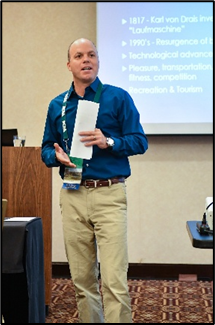
When done well, research strengthens professional practice by grounding innovation in evidence and by fostering collaboration between educators, students, and practitioners.
Research and scholarship have remained an important part of REC Net for many years. Members of the association’s educator network previously supported the publication of the Journal of Tourism Insights, helping create opportunities for scholarship connected to tourism, hospitality, recreation, and related industries.
REC Net has a longstanding history of supporting research, professional discussion, and scholarly exchange through conference sessions and symposium opportunities. That tradition continues today through the annual REC Net Research Symposium, which features peer-reviewed presentations along with published conference proceedings. The event encourages scholarship that connects academic insight with real-world industry practice.
| Advocacy |
Advocacy can take many forms within professional associations. While some organizations focus heavily on legislative advocacy or policy development, others advocate more informally by elevating professional voices, increasing industry visibility, and contributing to conversations about workforce development and professional practice.

Advocacy does not always happen in legislative spaces; it can also occur through storytelling, representation, and collective visibility that helps a profession better articulate its value and impact.
Some professional associations focus heavily on legislative advocacy or policy development. Due in part to our size and volunteer-led structure, REC Net has historically placed less emphasis on formal advocacy efforts and greater emphasis on professional connection, education, communication, and member support.
While REC Net does not focus heavily on formal legislative advocacy, member conversations through initiatives such as the REC Net Hotline help create space for discussion surrounding industry trends, professional challenges, and emerging issues within the field.
| Promotion of Standards |
Many professional associations engage in the promotion of standards through certifications, accreditation, or formal guidelines. These efforts can help establish consistency and accountability within a profession, but they also require significant administrative capacity and long-term oversight.
In industries connected to recreation, hospitality, resorts, campgrounds, and childcare programming, standards and regulations are often shaped by multiple outside entities including health departments, licensing agencies, insurers, accreditation bodies, and local or state governments. Because these standards vary widely across operational settings and regions, REC Net has historically focused more heavily on networking, education, communication, and professional support than on formal standards-setting or certification programs.
A Note on Professional Associations as Nonprofits
Professional associations like REC Net operate as nonprofit organizations designed to benefit people working within a specific industry. This structure is different from charitable nonprofits, which primarily focus on charitable or public-service missions.
REC Net operates as a 501(c)(6) nonprofit organization, a designation commonly used for professional associations, chambers of commerce, and industry groups. Unlike 501(c)(3) charitable nonprofits, which primarily focus on charitable or public-service missions, 501(c)(6) organizations are designed to support and advance the interests of a particular profession or industry.
The IRS recognizes more than 30 different types of 501(c) nonprofit organizations, each serving different purposes. Understanding these distinctions helps explain why professional associations often prioritize networking, education, communication, and industry support rather than direct charitable services.
Why This Matters
Professional associations are not meant to do everything. Instead, they exist to create value where it matters most for their members and the professions they serve.
Different professional associations emphasize different functions depending on their mission, membership, governance structure, volunteer capacity, and available resources. When viewed through these seven functions, it becomes easier to see how even smaller associations can have meaningful, lasting impact – often through a combination of connection, learning, recognition, and shared purpose.
Which of these functions has impacted you most through REC Net or another professional association?